You bought a rental property for $200,000. You sell it 10 years later for $400,000. That’s $200,000 in capital gains. If you’re in the 15% capital gains bracket plus state taxes (say 5%), you owe $40,000 in taxes. Ouch.
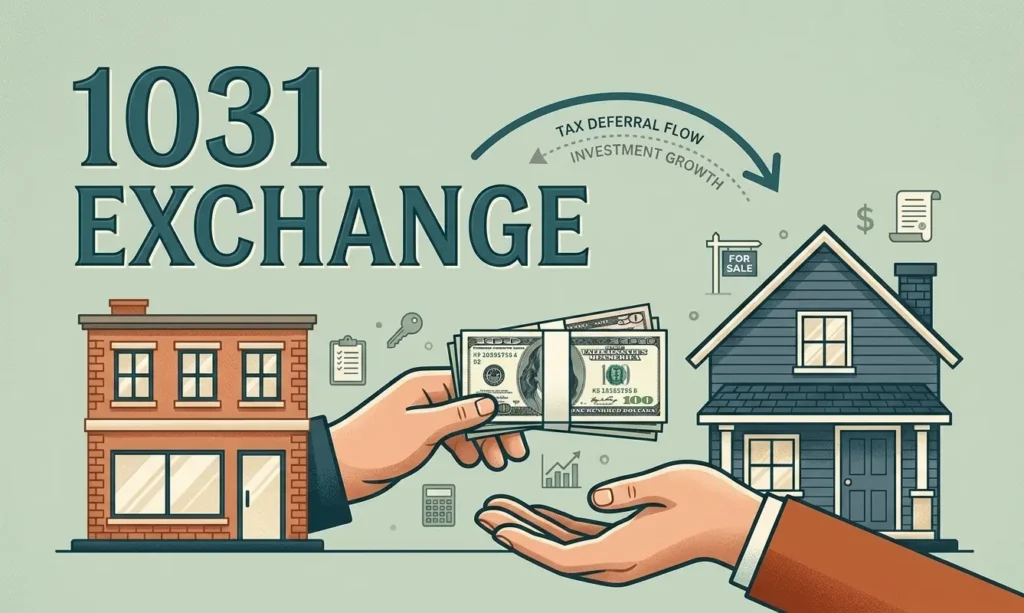
But what if you could defer every dollar of that tax – legally? Enter the 1031 exchange (named after Section 1031 of the Internal Revenue Code). It allows you to sell one investment property and buy another of “like kind” without paying capital gains tax at that time. You defer the tax until you eventually sell without exchanging.
In this guide, we cover the 2026 rules, deadlines, the critical role of the qualified intermediary, and common mistakes that kill your exchange.
How a 1031 Exchange Works – The Basics
Step 1: Sell your investment property (relinquished property).
Step 2: Use a Qualified Intermediary (QI) to hold your sale proceeds (you never touch the money).
Step 3: Within 45 days, identify potential replacement properties in writing.
Step 4: Within 180 days of the sale, close on one or more replacement properties.
Step 5: Defer all capital gains taxes.
The magic: Your tax basis from the old property transfers to the new property. When you eventually sell without exchanging, you pay tax on the total gain from both properties.
Important: This works for investment or business property only – not your primary residence (though there are partial exceptions).
The Two Critical Deadlines – Miss One, Pay Tax
1031 exchanges are unforgiving. There are no extensions.
Deadline #1 – 45 days to identify
You have 45 calendar days from the sale of your old property to submit a written list of potential replacement properties to your Qualified Intermediary.
What you can identify:
- 3‑property rule: Up to 3 properties of any value.
- 200% rule: Any number of properties, as long as their total fair market value does not exceed 200% of the value of the property you sold.
- 95% rule: Any number of properties, if you acquire at least 95% of their total value.
Most investors use the 3‑property rule – it’s simplest.
Deadline #2 – 180 days to close
You have 180 calendar days from the sale to close on one or more of the identified properties. This deadline includes weekends and holidays. If day 180 falls on a weekend, you still must close by that day (or earlier).
Pro tip: Do not rely on “banking days.” Close at least 1 week early if possible.
The Qualified Intermediary (QI) – Your Most Important Partner
You cannot touch the sale proceeds. Not for a minute. If the money lands in your personal bank account, the exchange is invalid, and you owe full taxes immediately.
The QI does:
- Receives the sale proceeds from the buyer.
- Holds the funds in a separate, secure account.
- Uses the funds to buy your replacement property.
- Issues tax reporting documents.
Choosing a QI in 2026:
- Use a nationally recognized firm (IPX1031, Asset Preservation, Inc., Exeter 1031).
- Avoid small, local QIs – there have been fraud cases where QIs stole funds.
- Verify the QI is bonded and insured.
- Ask: “Are funds held in a segregated trust account?”
Cost: $800 – $1,500 per exchange, plus small fees for wire transfers.
Like‑Kind Property – What Qualifies in 2026
“Like‑kind” is broader than you think. It means real estate used for business or investment. You can exchange:
- Apartment building for raw land
- Retail strip mall for industrial warehouse
- Single‑family rental for a duplex
- Farm for commercial office building
What is NOT like‑kind:
- Real estate in the US for real estate outside the US (foreign property).
- Your primary residence (unless you convert to rental first and hold for a period).
- Personal property (cars, equipment, art) – the Tax Cuts and Jobs Act eliminated personal property exchanges in 2018.
2026 clarification: The IRS has ruled that crypto‑backed real estate tokens are not like‑kind to physical real estate. Don’t try it.
Boot – The Taxable Part You Want to Avoid
“Boot” is any value you receive in the exchange that is not like‑kind property. Boot is taxable in the year of the exchange.
Types of boot:
- Cash boot: You take some of the sale proceeds instead of reinvesting them.
- Mortgage boot: Your new property has a lower mortgage than the old one. The difference is treated as cash boot.
- Personal property boot: The seller leaves furniture, and you keep it – taxable.
Example of mortgage boot:
- Old property sold for $500k, had $300k mortgage (net equity $200k).
- New property bought for $450k, with $250k mortgage (net equity $200k – same). No boot.
- But if new property has only $200k mortgage, your equity is $250k – you have $50k of mortgage boot (taxable).
How to avoid boot: Reinvest all net sale proceeds and acquire equal or greater debt.
Reverse Exchanges – Buy Before You Sell
What if you find the perfect replacement property before you sell your old one? That’s a reverse exchange. It’s more complex but legal.
How it works:
- A QI (or an “exchange accommodation titleholder”) takes title to the new property first.
- You have 180 days to sell your old property and complete the exchange.
- The QI holds the new property until your old one sells.
Cost: Higher – $3,000 – $6,000 in fees.
Risk: If you can’t sell your old property within 180 days, the exchange fails, and you may have to pay tax plus penalties.
When to use: Only when you’re certain you can sell quickly, and the new property is a once‑in‑a‑lifetime deal.
Improvement Exchanges – Building on Replacement Property
You can use a 1031 exchange to buy land and then build a building – but the construction must be completed within 180 days.
Process:
- Sell old property.
- Identify raw land as the replacement property.
- Enter into an “improvement agreement” with the QI.
- The QI pays for construction from the sale proceeds.
- All construction must be completed within the 180‑day window.
Reality check: 180 days is rarely enough for significant construction. Most investors use improvement exchanges only for small projects (finishing a basement, adding a garage).
Common 1031 Exchange Mistakes (That Cost Investors Thousands)
Mistake #1 – Missing the 45‑day identification deadline
Even one day late kills the exchange. Submit your identification in writing, via email or fax, to your QI. Keep proof of transmission.
Mistake #2 – Touching the money
Never have sale proceeds deposited into your personal account. Always direct the buyer to wire to your QI.
Mistake #3 – Using a related party
You cannot sell to a family member or an entity you control (like your LLC) and then do a 1031 exchange. The IRS disallows this.
Mistake #4 – Exchanging into a primary residence
If you buy a replacement property and move into it as your primary home, the IRS may audit and disallow the exchange. You must hold it as an investment for at least 12‑24 months first.
Mistake #5 – Forgetting state taxes
Some states (California, Pennsylvania, Massachusetts) do not fully conform to federal 1031 rules. You may owe state tax even if federal tax is deferred. Check with a CPA.
1031 Exchange vs. Opportunity Zones – Which Is Better in 2026?
Both defer capital gains, but differently.
| 1031 Exchange | Qualified Opportunity Zone (QOZ) | |
|---|---|---|
| Deferral period | Indefinite (until final sale) | Until 2026 (then tax due) |
| Tax reduction | None – full tax eventually | 10‑15% reduction if held 5‑7 years |
| Reinvestment requirement | 100% of proceeds into like‑kind | Capital gains only (not all proceeds) |
| Time limit | 180 days | 180 days |
| Best for | Active investors wanting to trade up | Passive investors wanting tax discount |
2026 note: The QOZ tax benefit is expiring. Gains deferred into QOZs must be recognized by December 31, 2026. Many investors are now favoring 1031 exchanges for long‑term deferral.
Do You Need a 1031 Exchange? When It Makes Sense
Yes, consider a 1031 if:
- You have a highly appreciated property ($100k+ in gains).
- You want to trade up to a larger or better‑located property.
- You’re moving from a high‑tax state to a no‑tax state (sell CA, buy TX).
- You want to consolidate multiple properties into one, or one into multiple.
No, don’t bother if:
- Your gain is under $50,000 – the transaction costs (QI fees, legal, etc.) may exceed the tax saved.
- You plan to hold the new property until you die (your heirs get a step‑up in basis, eliminating the gain).
- You need the cash for other investments (pay the tax and move on).
Conclusion
A 1031 exchange is one of the most powerful wealth‑building tools for real estate investors. In 2026, the rules remain strict: 45 days to identify, 180 days to close, use a qualified intermediary, and never touch the money. Miss any step, and you owe immediate taxes.
Our advice: Start planning your 1031 exchange at least 6 months before you sell. Interview QIs, line up replacement properties in advance, and work with a CPA who specializes in real estate.
Ready to execute a 1031 exchange? Countrywide Collective can connect you with experienced QIs and investor agents who can help you identify replacement properties fast.