The American dream of homeownership often feels out of reach for many, thanks to skyrocketing home prices and stubbornly high interest rates. For most prospective buyers, the single largest barrier isn’t the monthly mortgage payment—it’s the upfront cost. Coming up with a 20% down payment plus closing costs can take years of aggressive saving.
However, there is a massive misconception that you need 20% down to buy a house. In reality, there are billions of dollars in financial aid available to help you purchase a home. The secret is knowing where to look. First-time home buyer grants and down payment assistance programs are designed to bridge the gap between your savings and the keys to your front door.
This comprehensive 2,000-word guide will demystify the world of first-time home buyer grants, explain how down payment assistance programs work, detail the qualification requirements, and highlight the five critical mistakes you must avoid when applying for these funds in 2025.
What Are First-Time Home Buyer Grants?
A grant is essentially “free money” given to you to help cover your down payment or closing costs. Unlike a loan, a true grant does not have to be repaid as long as you meet specific occupancy requirements (usually living in the home for a set number of years).
First-time home buyer grants are typically funded by state and local Housing Finance Agencies (HFAs), as well as non-profit organizations. They are specifically targeted at buyers who are purchasing their first home, though the definition of “first-time” is more flexible than most people realize. According to the Department of Housing and Urban Development (HUD), you are considered a first-time buyer if you have not owned a principal residence in the past three years.
These grants are means-tested, meaning they are designed for low-to-moderate-income buyers. If your income exceeds the limits for your specific county, you will not qualify for the grant.
The Difference Between Grants and Down Payment Assistance Programs
While often used interchangeably, grants and down payment assistance programs (DPA) are not exactly the same. It is crucial to understand the difference when evaluating your financial options.
1. Grants (Forgivable Grants)
As mentioned, grants are true gifts that do not require repayment. However, they usually come with a “forgiveness period”—typically 5 to 15 years. If you live in the home for the entire forgiveness period, the grant is fully forgiven. If you sell, refinance, or move out of the home before the period expires, you may have to repay a pro-rated portion of the grant.
2. Deferred Payment Loans (Silent Seconds)
Many DPA programs are actually zero-interest, deferred-payment loans. Often called “silent seconds,” these loans sit behind your primary mortgage. You make no monthly payments on them, and they do not accrue interest. However, the full amount becomes due if you sell the home, refinance, or pay off the primary mortgage.
3. Low-Interest Loans
Some programs offer a low-interest second mortgage to cover your down payment. Unlike deferred loans, these require small monthly payments alongside your primary mortgage.
Top First-Time Home Buyer Grants and Programs for 2025
The landscape of first-time home buyer programs is vast and varies drastically by location. However, several national programs form the backbone of down payment help in the U.S.
1. Federal Housing Administration (FHA) Loans
While not a grant, the FHA loan is the most popular first-time home buyer program in the country. Backed by the federal government, FHA loans require as little as 3.5% down for buyers with a credit score of 580 or higher. They also have more lenient debt-to-income (DTI) requirements. You can pair an FHA loan with state-specific DPA grants to cover that 3.5% down payment.
2. Fannie Mae HomeReady and Freddie Mac Home Possible
These conventional loan programs require just 3% down and offer reduced mortgage insurance rates. They are designed for low-to-moderate-income buyers. To qualify, your income must be at or below 80% of the Area Median Income (AMI) for the property’s location. You can use gifts, grants, or down payment assistance funds to cover the 3% requirement.
3. State Housing Finance Agency (HFA) Programs
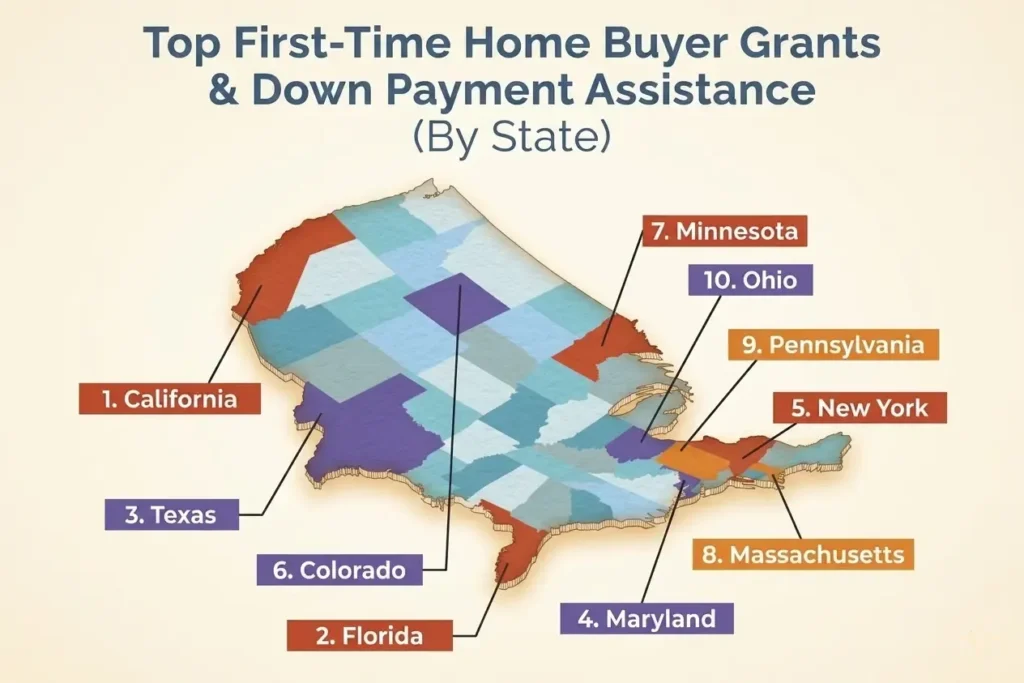
Every state has an HFA that offers localized grants and DPA. For example, the California Housing Finance Agency (CalHFA) offers the MyHome Assistance Program, which provides up to 3.5% of the purchase price for down payment or closing costs. The Florida Hometown Heroes program offers up to $35,000 in DPA for community workers. You must search your specific state’s HFA website to find the exact grants available in your area. The National Council of State Housing Agencies (NCSHA) is an excellent resource to find your local agency.
4. Good Neighbor Next Door (GNND)
Sponsored by HUD, the Good Neighbor Next Door program is a unique grant/discount for law enforcement officers, firefighters, emergency medical technicians, and teachers. If you buy a home in a designated revitalization area, you can receive a 50% discount on the list price. You must commit to living in the home for 36 months.
How to Qualify for First-Time Home Buyer Grants
Securing first-time home buyer grants requires navigating strict qualification guidelines. While every program has its own rules, here are the four universal criteria you must meet:
1. Income Limits
Grants are designed to help those who truly need it. Therefore, your household income cannot exceed the limits set by the program. Income limits are based on the Area Median Income (AMI) of your county. Some programs cap you at 80% AMI, while others allow up to 120% AMI.
2. Credit Score Requirements
Even though the grant covers your down payment, you still must qualify for a primary mortgage to buy the house. This means your credit score matters. Most DPA programs require a minimum FICO score of 640, though some will accept 620 if you are using an FHA loan. If your score is below 640, you should focus on credit repair before applying. To understand how your credit impacts your overall loan, read our comprehensive mortgage pre-approval guide.
3. Homebuyer Education Courses
Almost all first-time home buyer grants mandate that you complete a homebuyer education course. These courses, usually taken online for a small fee ($50-$100), teach you about the mortgage process, budgeting, and home maintenance. The certificate of completion is often valid for 12 months. Never skip this step, as it is a non-negotiable requirement for most financial aid.
4. Primary Residence Requirement
You cannot use grants or DPA to buy an investment property or a vacation home. The home must be your primary residence. Furthermore, the property must meet specific safety and structural standards, meaning heavily distressed properties might not qualify.
5 Mistakes to Avoid When Applying for Down Payment Help
The process of obtaining home buyer grants 2025 is fraught with red tape. Avoiding these five common mistakes will save you time, money, and heartbreak.
Mistake 1: Missing Local Programs
Most buyers only search for federal programs and miss out on the most lucrative grants. City and county-level programs often have higher payout limits and less competition. Always check your specific city’s official website for “community development” or “housing programs.”
Mistake 2: Taking on New Debt Before Closing
This is the most common reason grant-funded deals fall apart. Once you are pre-approved for a grant and a mortgage, your financial profile is frozen. If you finance a new car, open a credit card, or take out a personal loan before closing, your debt-to-income ratio will spike, and you will lose your grant funding.
Mistake 3: Missing the Homebuyer Education Deadline
Many buyers wait until they are under contract on a house to take the education course, only to find out the course takes two weeks to complete and the certificate takes 5 days to process. Take the course before you start house hunting. It will make you a more informed buyer and ensure you have your certificate ready when you need it.
Mistake 4: Assuming You Make Too Much Money
Do not assume your income disqualifies you. AMI limits are often surprisingly high, especially in high-cost-of-living areas. In some California counties, a family of four making $150,000 a year can still qualify for down payment assistance. Always check the specific AMI limits for your zip code.
Mistake 5: Not Working with an Approved Lender
You cannot apply for most state grants directly. You must work with a mortgage lender who is specifically approved by the state’s HFA to administer the program. If you go to a big bank that isn’t an approved participant, they won’t be able to process your grant application, and you will miss out on the funds. To learn more about how lender fees work, review our seller closing costs explained guide.

How the NAR Settlement Impacts Down Payment Assistance
The 2024 National Association of Realtors (NAR) settlement changed how buyer agent commissions are handled, and this has a nuanced impact on buyers using DPA. Because buyer agent compensation is no longer automatically offered by the seller on the MLS, buyers must negotiate this fee directly with their agent and include it in their purchase contract.
If you are using first-time home buyer grants, your grant funds can often be applied toward the buyer agent commission if it is financed into the closing costs. However, you must ensure your buyer agency agreement clearly outlines how the commission will be paid so your lender can properly structure the loan and apply the grant funds legally. Read our detailed breakdown of the real estate agent commission laws after the NAR settlement to ensure your grant strategy complies with the new rules.
Alternative Sources of Down Payment Help
If you do not qualify for state or local grants, you still have options to cover your down payment.
1. Gift Funds
Both FHA and conventional loans allow you to use gift funds from a family member for your down payment. The donor must provide a formal “gift letter” stating that no repayment is expected.
2. 401(k) Loans
You can borrow up to 50% of your vested 401(k) balance (up to $50,000) to use for a down payment. Because you are borrowing from yourself, you pay the interest back into your own retirement account. However, if you leave your job, the loan becomes due immediately.
3. Seller Concessions
While not a grant, you can negotiate seller concessions to cover your closing costs. This frees up your cash to be used entirely for the down payment. In a buyer’s market, sellers will often agree to pay 2% to 3% of the buyer’s closing costs to seal the deal.
Step-by-Step Guide to Securing Your Grant
If you are ready to take advantage of first-time home buyer grants, follow this exact sequence:
- Check Your Credit: Pull your credit report. If your score is below 640, spend 3-6 months paying down debt and disputing errors.
- Find an HFA-Approved Lender: Go to your state’s HFA website and use their “Find a Lender” tool. Interview two or three approved lenders to compare rates.
- Complete Homebuyer Education: Enroll in and complete an approved homebuyer education course. Save your certificate.
- Get Pre-Approved: Submit your financial documents to your chosen lender. They will determine which grants you qualify for and issue a pre-approval letter.
- House Hunt with an Agent: Partner with a real estate agent who understands how to write offers using DPA funds. The property must meet the program’s appraisal and safety standards.
- Close and Move In: Once the deal closes, you receive your grant funds, and you move into your new home. Remember to maintain primary residency to ensure the grant is fully forgiven.
Frequently Asked Questions (FAQs)
Do first-time home buyer grants need to be paid back?
Most first-time home buyer grants do not require repayment as long as you live in the home for the designated “forgiveness period,” which is typically 5 to 15 years. If you move out, sell, or refinance before this period ends, you may have to repay a pro-rated amount of the grant. Always read the terms of your specific program.
Can I use a grant for closing costs?
Yes. Many down payment assistance programs allow you to apply the funds toward both your down payment and your closing costs. Closing costs typically run between 2% and 5% of the loan amount. You can also negotiate seller concessions to cover any remaining balance.
What credit score is needed for a first-time home buyer grant?
While it varies by program, most grants require a minimum credit score of 640. If you are using an FHA loan with a DPA grant, some programs may accept a score as low as 620. You can check your credit score for free through AnnualCreditReport.com.
How much money can I get from down payment assistance?
The amount varies wildly by location. Some programs offer a flat $10,000, while others offer 3% to 5% of the home’s purchase price. In high-cost areas, some state programs offer up to $50,000 or more in down payment help. Check your local Housing Finance Agency for exact figures.
Are first-time home buyer grants only for low-income buyers?
Not necessarily. While the programs are designed for low-to-moderate-income buyers, the income limits are tied to the Area Median Income (AMI). In expensive cities, a family making $120,000 a year might still fall under the 80% AMI threshold and qualify for full grant funding.
Conclusion: Free Money is Waiting for You
The barrier to entry for homeownership is lower than you think. Millions of dollars in first-time home buyer grants go unclaimed every year simply because buyers don’t know they exist or assume they won’t qualify. By educating yourself on down payment assistance programs, completing your homebuyer education, and partnering with the right lender, you can drastically reduce your upfront costs and start building generational wealth through real estate.
Do not let the fear of a down payment keep you renting. If you are ready to explore your options, Countrywide Collective is here to help. Our vertically integrated platform connects you with trusted, HFA-approved lenders and expert real estate agents who know how to navigate grant-funded transactions.
Ready to see how much free money you qualify for? Contact Countrywide Collective today to get matched with a grant-approved lender and start your journey to homeownership.