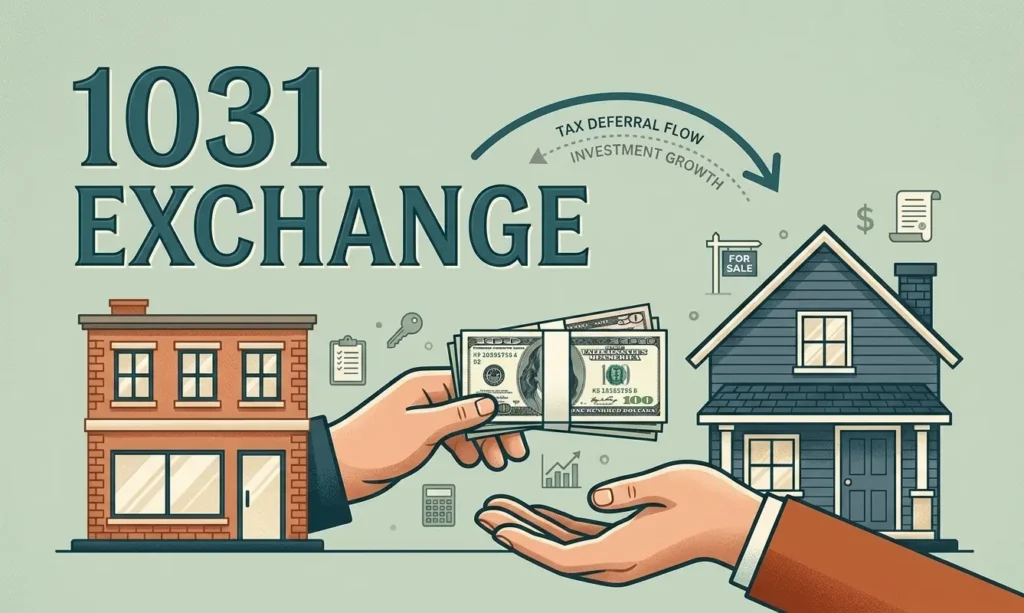
For real estate investors, building wealth is only half the battle; keeping it from the taxman is the other. When you sell an investment property for a significant profit, the IRS is waiting to collect a hefty capital gains tax—often up to 20% federally, plus state taxes and the 3.8% Net Investment Income Tax. However, Section 1031 of the Internal Revenue Code offers a perfectly legal, highly powerful loophole: the 1031 tax-deferred exchange.
A 1031 exchange allows you to sell an investment property and reinvest the proceeds into a new property, deferring all capital gains taxes. While this is an incredible wealth-building tool, the IRS does not make it easy. The 1031 exchange rules are notoriously strict, complex, and unforgiving. A single missed deadline or improper structuring can trigger a massive tax bill and severe penalties.
This comprehensive 2,000-word guide will walk you through everything you need to know about executing a successful exchange in 2025. We will break down the like-kind property requirements, explain the rigid 1031 exchange timeline, and highlight the most common 1031 exchange pitfalls you must avoid to protect your hard-earned equity.
What is a 1031 Exchange?
Named after Section 1031 of the Internal Revenue Code, a 1031 exchange (also known as a Starker exchange or tax-deferred exchange) is a swap of one investment asset for another. Because the IRS views this as a continuation of your original investment rather than a realization of profit, no capital gains taxes are due at the time of the sale. Instead, the tax basis from your old property carries over to the new property, and the taxes are deferred until you eventually sell the new property for cash (without doing another exchange).
The primary benefit is clear: deferred capital gains tax. By deferring taxes, you keep your money working for you. You can use the full amount of your equity to purchase a larger, more profitable property, accelerating your portfolio’s growth.
Core 1031 Exchange Rules You Must Follow in 2026
To successfully defer your taxes, you must adhere to several foundational 1031 exchange rules. The IRS does not allow informality in this process. Every “i” must be dotted, and every “t” must be crossed.
1. Property Must Be Held for Investment
The most critical rule is that both the property you are selling (the relinquished property) and the property you are buying (the replacement property) must be held for productive use in a trade or business or for investment.
You cannot exchange your primary residence or a vacation home you use personally. However, you can exchange a rental property, commercial building, or raw land. If you try to exchange a property you recently flipped or lived in, the IRS will disallow the exchange. Generally, the IRS looks for a holding period of at least one to two years to prove investment intent.
2. Like-Kind Property Requirements
The term “like-kind” is one of the most misunderstood aspects of the 1031 exchange. Under the like-kind property requirements, the properties do not need to be identical. “Like-kind” refers to the nature or character of the property, not its grade or quality.
This means you can exchange:
- A single-family rental home for a duplex.
- An apartment building for a retail strip center.
- Raw, undeveloped land for a commercial office building.
- A condo for a warehouse.
As long as both properties are real property held for investment in the United States, they are considered like-kind. You cannot, however, exchange real estate for personal property, stocks, or partnership interests.
3. Equal or Greater Value and Equity
To defer 100% of your capital gains taxes, you must reinvest all of your net proceeds into the replacement property. This means the replacement property must be of equal or greater value, and you must use all of your equity to acquire it.
If you receive any cash or debt relief (known as “boot”) during the exchange, that portion will be taxable. For example, if you sell a property for $500,000 and buy a replacement for $450,000, the $50,000 difference (boot) is subject to capital gains tax.
4. The Use of a Qualified Intermediary
Perhaps the strictest of all 1031 exchange rules is the requirement to use a Qualified Intermediary (QI). The QI is an independent third party who holds the proceeds from the sale of your relinquished property and uses them to purchase the replacement property on your behalf.
You cannot touch the money. If the funds from the sale hit your bank account, even for one second, the exchange is void, and you will owe taxes on the entire amount. The QI prepares the exchange agreement, holds the funds in a secure escrow account, and coordinates the closings. Choosing a reputable, bonded QI is essential to safeguarding your funds.
The Strict 1031 Exchange Timeline
Timing is everything in a 1031 exchange. The IRS imposes two absolute, non-negotiable deadlines. If you miss either of these deadlines by even one day, your exchange fails, and you will owe the full capital gains tax.
The 45-Day Identification Rule
Starting from the exact date you close on the sale of your relinquished property, you have exactly 45 calendar days to formally identify your potential replacement property (or properties) in writing. This written identification must be signed by you and delivered to your Qualified Intermediary before midnight of the 45th day.
Weekends and holidays count. There are no extensions for acts of God, natural disasters, or personal emergencies.
When identifying properties under the 45-day identification rule, you must follow one of three IRS guidelines:
- The Three-Property Rule: You can identify up to three separate properties, regardless of their total market value. This is the most common rule used by investors.
- The 200% Rule: You can identify any number of properties, but their total combined value cannot exceed 200% of the value of the property you sold.
- The 95% Rule: You can identify any number of properties of any value, but you must actually acquire and close on 95% of the total value identified. This rule is rarely used due to its difficulty.
The 180-Day Closing Rule
The second half of the 1031 exchange timeline dictates that you must close on the purchase of your replacement property (or properties) no later than 180 calendar days after the closing date of your relinquished property.
Again, this deadline is absolute. The 180 days includes the initial 45-day identification period. Therefore, once you have identified your property, you have roughly 135 days left to finalize the purchase, secure financing, and close the deal. If your replacement property is located in a federally declared disaster area, the IRS may grant deadline extensions, but you should never rely on this.
Top 5 Common 1031 Exchange Pitfalls to Avoid
Even seasoned investors can stumble over the complexities of a 1031 exchange. Here are the top five 1031 exchange pitfalls that can derail your tax deferral and cost you a fortune.
Pitfall 1: Taking Constructive Receipt of Funds
As mentioned, you cannot touch the money. This rule extends to having access to the funds or receiving any economic benefit from them before the exchange is complete. Some sellers attempt to have the QI wire the funds to their attorney, their accountant, or even use the funds to pay off personal debts before the exchange closes. This is known as “constructive receipt” and instantly invalidates the exchange.
Pitfall 2: Missing the 45-Day Deadline
The 45-day identification period is where most exchanges fail. Investors often underestimate how difficult it is to find a suitable investment property in just six weeks. In hot real estate markets, good properties are snatched up quickly. If you wait until day 30 to start looking, you will likely panic and identify a property you don’t actually want, or miss the deadline entirely.
Pitfall 3: Failing to Replace Debt
If you had a mortgage on your old property, you must have a mortgage of equal or greater value on the new property to defer all taxes. If you pay off your old mortgage and buy the new property in cash, the amount of debt you paid off is considered “mortgage boot” and is taxable. Many investors forget to account for this debt replacement requirement when calculating their purchasing power.
Pitfall 4: Partnership Interest Issues
You cannot exchange a partnership interest for real property. If you own a property through an LLC or a partnership, you cannot simply do a 1031 exchange at the entity level. The property must be deeded out of the partnership, which can trigger complex legal and tax issues. In some cases, investors must dissolve the partnership or use a “drop and swap” strategy, which requires careful structuring by a real estate tax attorney.
Pitfall 5: Poor Planning and Lack of Professional Guidance
A 1031 exchange is not a DIY project. It requires a team of professionals, including a Qualified Intermediary, a CPA, a real estate attorney, and an experienced real estate agent. Failing to consult these professionals before listing your property for sale is a recipe for disaster. You must have your exchange strategy mapped out before you ever sign a listing agreement.
Advanced Strategies: The Reverse 1031 Exchange
While the traditional 1031 exchange requires you to sell your property first and then buy a new one, sometimes the perfect replacement property becomes available before you have sold your current asset. In this scenario, you can utilize a reverse 1031 exchange.
A reverse exchange allows you to acquire the replacement property first, and then sell your relinquished property within 180 days. This is significantly more complex than a standard exchange. Because you cannot hold both properties in your own name simultaneously, the QI must take title to the replacement property (a process called “parking”) using a special-purpose entity.
Reverse exchanges require substantial upfront capital, as you must finance the new property without the proceeds from the old one, and the legal fees are typically higher. However, for investors who find a rare, highly desirable property, it is an invaluable tool. You can learn more about the intricacies of reverse exchanges from the Federation of Exchange Accommodators.
How the IRS is Auditing 1031 Exchanges in 2026
In recent years, the IRS has increased its scrutiny of 1031 exchanges. With the passage of the Inflation Reduction Act, the IRS received additional funding for enforcement, and 1031 exchanges are a prime target for revenue recovery.
In 2025, the IRS is specifically auditing exchanges for “constructive receipt” violations and improper holding periods. If the IRS determines that you purchased a property with the primary intent to resell it quickly (flipping) rather than hold it for investment, they will disallow the exchange and retroactively apply the capital gains tax, plus interest and penalties.
It is more important than ever to maintain meticulous records. Keep all lease agreements, tax returns (showing rental income), and property management contracts to prove your investment intent. For a deeper dive into the tax implications of real estate investments, review the IRS guidelines on like-kind exchanges.
Integrating 1031 Exchanges into Your Real Estate Strategy
A 1031 exchange is not just a tax loophole; it is a foundational pillar of a long-term real estate tax strategy. By continuously exchanging properties, investors can defer millions of dollars in taxes over a lifetime, allowing their portfolios to compound exponentially. Furthermore, when you eventually pass away, your heirs inherit the property at a “stepped-up” basis, meaning all the deferred capital gains taxes are permanently erased.
If you are planning to sell an investment property, it is crucial to work with a real estate platform that understands the urgency of the 45-day and 180-day deadlines. At Countrywide Collective, we specialize in helping investors source off-market replacement properties quickly. Whether you need to deploy capital from a recent sale or want to offload a management-heavy asset, our vertically integrated platform ensures speed, clarity, and clean execution. Explore our investment opportunities to find your next like-kind property.
Conclusion: Protect Your Equity
The 1031 exchange rules are strict, but the financial rewards are unmatched. By understanding the like-kind property requirements, adhering to the 45-day and 180-day deadlines, and avoiding common pitfalls like constructive receipt, you can defer hundreds of thousands of dollars in capital gains taxes and accelerate your wealth-building journey.
Never attempt a 1031 exchange without a qualified team in your corner. Before you list your investment property for sale, consult with a CPA and a Qualified Intermediary to ensure your transaction is structured perfectly from day one.
Ready to sell your investment property and execute a 1031 exchange? Contact Countrywide Collective today. Our team of experts will help you navigate the complexities of the exchange, source high-quality replacement properties, and ensure you meet every IRS deadline with confidence.