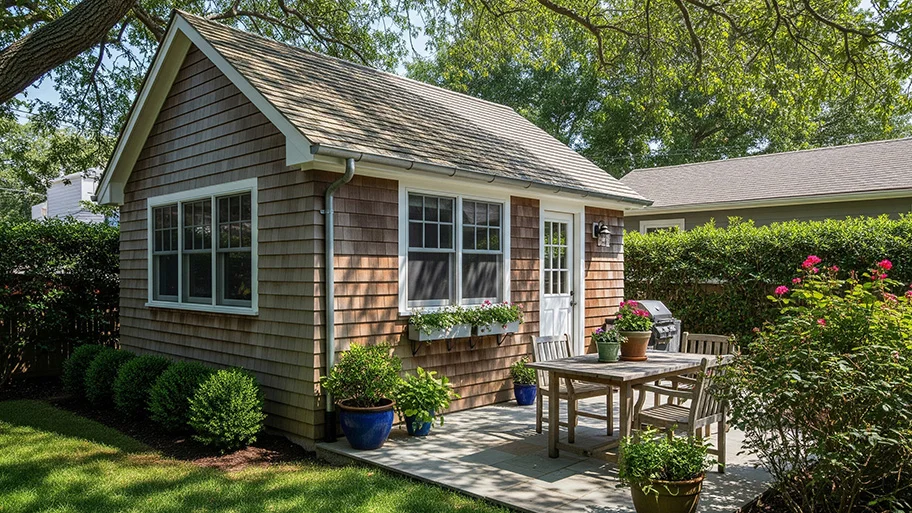
Imagine building a small, separate home in your backyard – and renting it out for $1,500‑$2,000 per month. That’s an Accessory Dwelling Unit (ADU) . Also known as granny flats, in‑law suites, or backyard cottages, ADUs are exploding in popularity.
Why? Because housing is expensive, and ADUs add rental income, multi‑generational living space, or a home office without buying a new property. And in many states, laws have changed to make ADUs much easier to build.
This guide explains what an ADU is, state‑by‑state laws, typical costs, and how to calculate your return on investment.
What Exactly Is an ADU?
An ADU is a secondary dwelling unit on the same lot as a primary single‑family home. It has its own:
- Entrance (separate from main house)
- Kitchen
- Bathroom
- Sleeping area
- Living space
Three types of ADUs:
| Type | Description | Typical Cost |
|---|---|---|
| Detached ADU | Freestanding structure (backyard cottage) | $150k‑$250k |
| Attached ADU | Addition to existing home (e.g., above garage) | $100k‑$180k |
| Conversion ADU | Converting existing space (garage, basement, attic) | $50k‑$100k |
Not an ADU: A simple bedroom with a shared bathroom. Must have full kitchen and separate entrance.
Why ADUs Are Booming – Three Trends
1. Housing shortages – Cities need more units. ADUs are “gentle density” – they add homes without changing neighborhood character.
2. Rental income – A well‑built ADU can pay for itself in 5‑10 years, then generate profit.
3. Multi‑generational living – Aging parents or adult children can live nearby but independently.
ADU Laws by State (2025‑2026 Updates)
State laws vary dramatically. Here are the most ADU‑friendly states and key rules.
California – Most Progressive
- Owner occupancy: Not required (you can rent both main house and ADU).
- Size: Up to 800 sq ft for 1‑bedroom, 1,000 sq ft for 2‑bedroom.
- Setbacks: 4 feet from rear/side property lines (or existing structure line).
- Parking: Not required if within 0.5 mile of public transit.
- 2025 update: ADUs can now be sold separately as condos (under certain conditions).
Oregon
- Owner occupancy: Required on one unit (main or ADU).
- Size: Up to 900 sq ft for detached ADU.
- Setbacks: Same as primary dwelling.
- 2025 update: No parking required anywhere in Portland metro.
Washington
- Owner occupancy: Not required if ADU is rented (but must register).
- Size: Up to 1,000 sq ft or 50% of primary home (whichever smaller).
- Setbacks: 5 feet from rear/side.
- 2025 update: ADUs allowed on all residential lots statewide (no local bans).
Colorado
- Owner occupancy: Required.
- Size: Up to 800 sq ft or 40% of primary home.
- Setbacks: Varies by city (many allow 5 feet).
- 2025 update: Denver eliminated parking requirements for ADUs.
Texas
- Owner occupancy: Not required (investor friendly).
- Size: Up to 1,100 sq ft in Austin; varies elsewhere.
- Setbacks: Varies by city (many allow 10 feet).
- Note: Texas has no statewide ADU law; check your city.
New York
- Owner occupancy: Required (except NYC where rules are complex).
- Size: Varies by city.
- Setbacks: Varies.
- Note: NYC has strict rules; Upstate NY is more flexible.
States with no statewide ADU law (local rules only): Florida, Illinois, Pennsylvania, Ohio, Georgia, North Carolina, Arizona, Nevada. Check your city/county.
ADU Costs – What You’ll Actually Pay
Costs vary by region, size, and finish level. Here are 2025‑2026 averages:
| Type | Low | Average | High |
|---|---|---|---|
| Detached ADU (500‑800 sq ft) | $120,000 | $180,000 | $250,000 |
| Attached ADU (400‑600 sq ft) | $80,000 | $130,000 | $200,000 |
| Garage conversion (400‑600 sq ft) | $50,000 | $85,000 | $120,000 |
| Basement conversion (500‑800 sq ft) | $60,000 | $100,000 | $150,000 |
Cost per square foot: $200‑$350 (higher in coastal cities).
Hidden costs:
- Permits and fees: $5,000‑$15,000
- Utility connections (separate meter): $2,000‑$5,000
- Site work (grading, landscaping): $5,000‑$15,000
- Design/architect fees: $5,000‑$15,000
Total all‑in: Often $150k‑$250k for a detached ADU.
ADU Rental Income – How Much Can You Earn?
Rents vary by market. Here are examples:
| City | Typical ADU Rent (1‑bed) | Annual Income |
|---|---|---|
| Los Angeles, CA | $2,200 | $26,400 |
| Portland, OR | $1,800 | $21,600 |
| Denver, CO | $1,700 | $20,400 |
| Austin, TX | $1,800 | $21,600 |
| Seattle, WA | $2,000 | $24,000 |
| Cleveland, OH | $1,200 | $14,400 |
Pro tip: ADUs rent for slightly less than a full apartment (no separate address, shared lot). But demand is high.
ADU ROI – Does It Pay Off?
Let’s run numbers on a typical detached ADU.
Assumptions:
- Cost: $180,000 (financed with a home equity loan at 8% over 15 years)
- Monthly rent: $1,800
- Vacancy (5%): $90
- Property management (8% if you don’t self‑manage): $144
- Maintenance (10% of rent): $180
- Utilities (if you pay): $150
- Insurance increase: $50
Monthly cash flow before mortgage: $1,800 – $90 – $144 – $180 – $150 – $50 = $1,186
Mortgage payment (15 years, 8%): $1,720 (on $180k)
Wait – that’s negative cash flow ($534/month loss)? Yes, if you finance 100% at 8%. That’s why many ADU builders pay cash or use a HELOC with interest‑only payments.
Better scenario – pay cash:
- Investment: $180,000 cash
- Annual net income (after expenses): $1,186 × 12 = $14,232
- Cash‑on‑cash return: 7.9%
That beats many bonds and is comparable to stock market long‑term.
Payback period: 180,000 / 14,232 = 12.6 years. Then pure profit.
Verdict: ADUs make sense if you pay cash or have very low financing costs. If you need a high‑interest loan, the numbers are tight.
How to Finance an ADU
Options from best to worst:
1. Cash – Best return, but ties up capital.
2. Home equity loan or HELOC – Interest rates 7‑9%. HELOC offers interest‑only payments during construction.
3. Cash‑out refinance – Replace your primary mortgage with a larger one. Works if your existing rate is high (above 6%).
4. Construction loan – Higher rates (9‑12%) but converts to permanent mortgage.
5. Personal loan – Only for small conversions (<$50k). Rates 10‑18%.
Pro tip: Some states offer ADU grants or low‑interest loans. California has the ADU Grant Program ($40,000 for pre‑development costs). Check your state housing agency.
Step‑by‑Step to Build an ADU
1. Check local zoning – Setbacks, height limits, parking requirements.
2. Hire an ADU specialist architect – They know local codes.
3. Get permits – 3‑9 months in coastal cities; faster in Midwest.
4. Choose a contractor – Get 3 bids. Ask for ADU experience.
5. Build – 6‑12 months for detached; 3‑6 months for conversion.
6. Get certificate of occupancy – Final inspection.
7. Rent it – List on Zillow, Apartments.com, or local rental sites.
Common ADU Mistakes to Avoid
- Underestimating utility connection costs – Separate meters can cost $5k‑$10k.
- Forgetting fire separation – Detached ADUs must be 10 feet from main house or have fire‑rated siding.
- Ignoring parking requirements – Some cities require an extra parking space for the ADU.
- Building too small – A 400 sq ft ADU rents for only slightly less than 600 sq ft, but costs much less. Aim for 500‑600 sq ft.
Conclusion
ADUs are a powerful way to add rental income, house family members, or increase property value. The best states for ADUs are California, Oregon, Washington, and Colorado, where laws are most permissive. Costs range from $50k for a garage conversion to $250k for a high‑end detached ADU. Payback periods are typically 10‑15 years, after which you have a cash‑flowing asset.
Thinking of building an ADU? Countrywide Collective can connect you with contractors, architects, and lenders who specialize in ADU projects.