The #1 barrier to homeownership isn’t the monthly payment – it’s the down payment. In 2026, the median down payment for first‑time buyers is 8%, or about $32,000 on a $400,000 home. For many families, that’s years of saving.
But there’s good news: over 2,000 down payment assistance (DPA) programs exist across the USA. Some offer grants (free money), others offer low‑interest second mortgages. And in 2026, a new federal program – the First‑Gen Home Buyer Credit – adds up to $15,000.
This guide covers the top 5 national and state programs for 2026, plus a state‑by‑state directory so you can find help where you live.
What Is Down Payment Assistance (DPA)?
DPA programs help buyers cover:
- Down payment (usually 3‑5% of purchase price)
- Closing costs (2‑5% of purchase price)
Types of DPA:
- Grant – Never repay. Best option.
- Forgivable loan – Repaid only if you sell or move within a certain period (usually 3‑5 years).
- Deferred loan – No payments, but repaid when you sell or refinance.
- Low‑interest second mortgage – Monthly payments, but low rate.
Eligibility typically requires:
Completion of a homebuyer education coursee with the 50‑year average (about 6.5%). They are not “high” by historical standards – but they feel high because we got used to 3%.
First‑time buyer (or not owned a home in 3 years)
Income below 80% or 120% of area median income (AMI)
Purchase price below local limits
#01 – New Federal Program: First‑Gen Home Buyer Credit (2026)
What it is: A refundable tax credit of up to $15,000 or 10% of the home price (whichever is lower). Unlike a deduction, a refundable credit means you get money back even if you owe no taxes.
Eligibility:
- First‑time buyer whose parents never owned a home.
- Income ≤ 120% of area median income (or ≤ 160% in high‑cost areas).
- Home price ≤ 110% of local median purchase price.
Repayment: None, unless you sell within 4 years. Then you repay a prorated amount (e.g., sell in year 2, repay 50%).
How to claim: File IRS Form 5405 with your tax return. The credit can be advanced to closing – meaning you can use it as a down payment immediately.
Availability: January 1, 2026 – December 31, 2028. Funding is $10 billion over 3 years.
Our take: This is the most significant new DPA program in a decade. If you qualify, it’s free money. Apply through a participating lender.
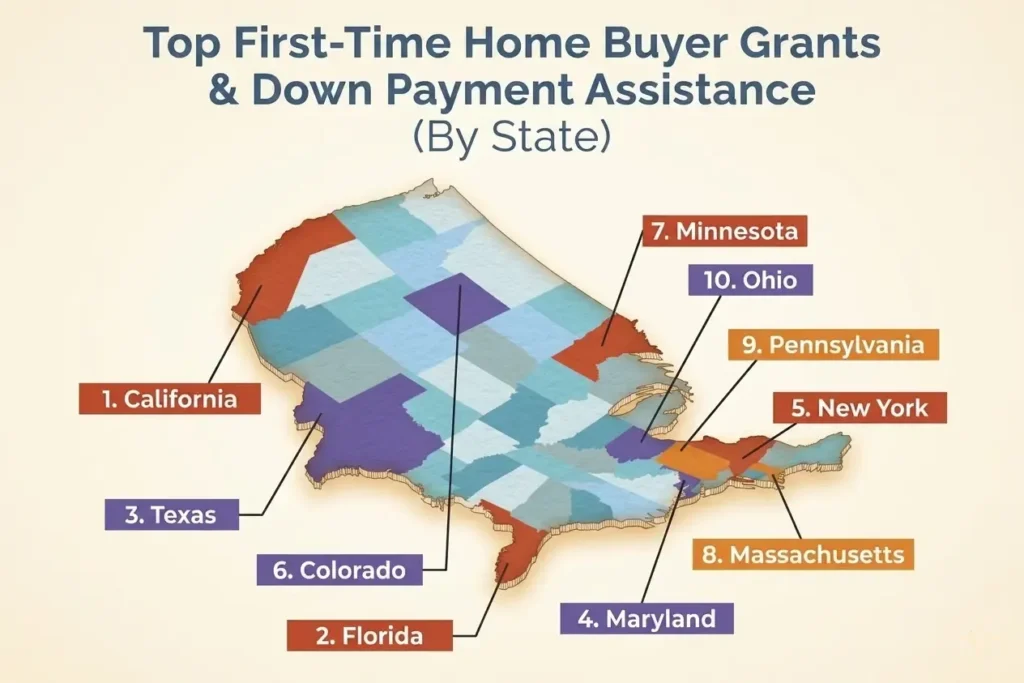
#02 – California Dream For All Shared Appreciation
What it is: The state provides 20% of the purchase price as a down payment assistance loan. You repay the 20% plus 20% of any home appreciation when you sell.
Example: Buy a $500,000 home. State gives $100,000 (20%). You sell 5 years later for $600,000. You repay $100,000 + 20% of $100,000 appreciation = $120,000.
Eligibility:
- First‑time buyer (or not owned in 7 years).
- Income ≤ 150% of area median income (higher in expensive counties).
- One borrower must be first‑gen (parents never owned).
2026 update: Program funding was replenished in March 2026 with $500 million. It typically runs out in 2‑3 months, so apply early.
Pros: No monthly payment, no interest.
Cons: You share appreciation, so less profit when you sell.
#03 – Texas Homebuyer Program (5% Grant)
What it is: A true grant – you never repay. Up to 5% of the loan amount, capped at $15,000.
How it works: You use a participating lender and take a Texas Department of Housing (TDH) mortgage. The grant is applied to down payment and closing costs.
Eligibility:
- First‑time buyer (or not owned in 3 years) – but veterans exempt.
- Income limits: $70,000 – $110,000 depending on county.
- Purchase price limit: $350,000 – $450,000.
2026 update: TDH increased income limits by 10% to account for inflation. Also added a “teacher next door” bonus of $5,000.
Best for: Buyers in Dallas, Houston, Austin, San Antonio – but many suburban areas also qualify.
#04 – Chenoa Fund (Nationwide)
What it is: A privately funded DPA program available through participating lenders in all 50 states. Offers a forgivable second mortgage of 3.5% of the purchase price.
How forgiveness works: Stay in the home for 3 years, and the loan is 100% forgiven. Move earlier, and you repay a prorated amount.
Eligibility:
- Must use an FHA loan.
- Minimum credit score 580.
- Income ≤ 135% of AMI (higher in high‑cost areas).
2026 update: Chenoa now offers a 5% forgivable option for buyers with credit scores above 640.
Pros: Nationwide, forgivable, no monthly payment.
Cons: Only for FHA loans (which have MIP for life)ential drop of 0.2‑0.3% over the next few months is not worth the risk of a sudden spike. If rates do drop significantly after you lock, you can always refinance later.
#05 – State‑Specific Standout Programs
Beyond the top four, these state programs are exceptional in 2026:
New York – HomeFirst Down Payment Assistance:
$100,000 grant for buyers in NYC (5 boroughs). Requires 3% buyer contribution and homebuyer course.
Illinois – ICHA Access Forgivable Loan:
$10,000 forgivable after 5 years. Income limits up to $120,000 in Chicago suburbs.
Florida – HFA Preferred 2nd Mortgage:
Up to $10,000 at 0% interest, deferred until sale. No monthly payments.
Pennsylvania – Keystone Advantage Assistance Loan:
$5,000 – $10,000 forgivable after 5 years. Works with FHA, VA, USDA.
Ohio – Ohio Housing Finance Agency (OHFA) Grant:
5% of loan amount (up to $15,000) – true grant, never repay. Income limits generous ($120k for family of 4 in Columbus).
How to Find DPA Programs in Your State – Step by Step
Step 1: Visit the HUD Exchange DPA database (hudexchange.info/dpa).
Step 2: Select your state and county.
Step 3: Review income and purchase price limits.
Step 4: Contact a participating lender (list provided).
Step 5: Complete a homebuyer education course (usually $50‑$100 online).
Alternative: Use DownPaymentResource.com – a private database updated monthly.
Pro tip: Many DPA programs are “silent seconds” – they don’t require monthly payments. Your primary mortgage lender will need to approve the second lien, so choose a lender experienced with DPA.
Common Mistakes That Disqualify Buyers
Income just above the cap – Some programs have “soft” caps; ask about exceptions.
Purchase price over the limit – In hot markets, you may need to look at lower‑priced neighborhoods.
Missing the homebuyer course – Do this before you apply; it takes 4‑6 hours.
Using a non‑participating lender – DPA programs work only with approved lenders. Ask before you apply.
Do You Need to Be a First‑Time Buyer? Not Always.
Many programs define “first‑time” as not having owned a home in the past 3 years. But some programs – especially for veterans, teachers, or essential workers – waive the first‑time requirement.
Example: The new First‑Gen Credit requires that your parents never owned. You could have owned before and still qualify.
Check the fine print on every program.
Conclusion
Down payment assistance can turn “someday” into “today.” In 2026, the new First‑Gen Home Buyer Credit alone could put $15,000 in your pocket. Combine that with state grants, and you might buy a home with zero out‑of‑pocket cash.
Your next step: Take 30 minutes to search DPA programs in your state. Then call a Countrywide Collective agent – we work with lenders who specialize in DPA and can help you layer multiple programs.