The journey to homeownership is one of the most exciting milestones of your life, but it is also the largest financial transaction you will likely ever make. In today’s economic landscape—characterized by fluctuating interest rates, rising insurance premiums, and persistent housing inventory shortages—buyers are facing a unique affordability challenge.
If you are sitting at your computer, staring at real estate listings, and asking yourself, “how much house can I afford?”, you are already taking the right first step. Far too many buyers fall in love with a property before running the numbers, only to have their hearts broken when the lender denies their mortgage application.
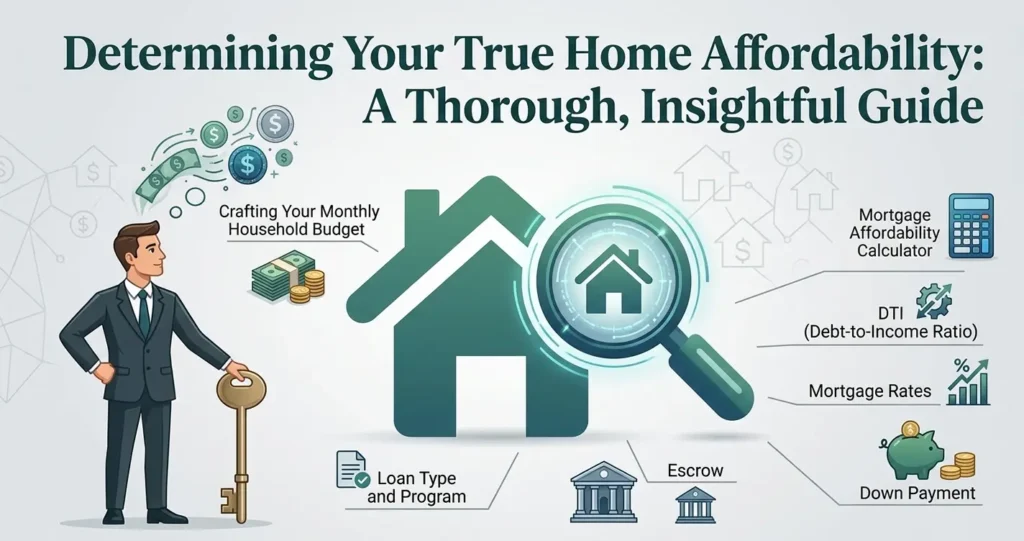
Determining your budget is not about finding the maximum loan amount a bank will give you; it is about understanding what monthly payment fits comfortably into your lifestyle without causing financial stress. This comprehensive guide will teach you exactly how to calculate home affordability, master the 28/36 rule, understand your Debt-to-Income (DTI) ratio, and uncover the hidden costs of homeownership that lenders rarely discuss.
The Core Formula: How Much House Can I Afford?
When you ask a lender, “how much house can I afford?”, their answer is usually based on a rigid mathematical formula. However, you must remember that the bank’s primary goal is to sell you a loan, not to ensure you can still afford to travel, dine out, or save for retirement. Lenders look at your gross income (before taxes), while you have to live on your net income (after taxes).
To find your true budget, you must look beyond the bank’s pre-approval letter. You need to evaluate your complete financial picture, including your existing debts, future goals, and the true cost of maintaining a property.
The 28/36 Rule: The Golden Standard of Affordability
The most widely accepted benchmark used by financial advisors and mortgage underwriters to determine how much house can I afford is the 28/36 rule. This rule sets strict limits on how much of your gross monthly income should go toward housing and total debt.
The 28% Front-End Ratio
The “28” refers to your front-end ratio. This dictates that your total monthly housing costs—often referred to as PITIA (Principal, Interest, Property Taxes, Homeowners Insurance, and HOA dues if applicable)—should not exceed 28% of your gross monthly income.
- Example: If your gross household income is $100,000 per year, your gross monthly income is $8,333. Under the 28% rule, your maximum monthly housing payment should be $2,333.
The 36% Back-End Ratio
The “36” refers to your back-end ratio, also known as your Debt-to-Income (DTI) ratio. This rule states that all of your monthly debt obligations combined—your housing payment, plus credit cards, student loans, auto loans, and child support—should not exceed 36% of your gross monthly income.
- Example: Using the same $8,333 gross monthly income, 36% is $3,000. If your housing payment is $2,333, you only have $667 left in your DTI budget for all other debt. If your car payment is $400 and your student loans are $300, you have hit your maximum DTI limit.
If you exceed the 36% back-end ratio, you will struggle to get approved for a conventional mortgage, even if your credit score is flawless.
Understanding Your DTI Ratio for Mortgage Approval
Your DTI ratio for mortgage approval is the single most important metric a lender uses to assess your risk as a borrower. It proves to the bank that you have the cash flow to handle the monthly payments.
How to Calculate Your DTI
Calculating your DTI is simple. First, add up all your monthly debt payments as they appear on your credit report:
- Minimum credit card payments
- Student loan payments (even if in forbearance, lenders use 1% of the balance)
- Auto loan payments
- Personal loans
- Alimony or child support
Next, divide that total by your gross monthly income (before taxes). Multiply by 100 to get your percentage.
The DTI Thresholds
- 43% or lower: This is the maximum DTI allowed for most qualified mortgages. If your DTI is above 43%, you will likely be denied.
- 36% to 42%: You are in the caution zone. You might get approved, but your budget will be very tight.
- Below 36%: You are in the safe zone and will have an easier time securing a loan with favorable terms.
If your DTI is too high, you either need to increase your income, pay down your debts, or buy a less expensive house. Use a reliable home affordability calculator to plug in your specific numbers and see where you stand.
How to Calculate Home Affordability Like a Lender
To truly understand how much house can I afford, you have to look at the three variables that dictate your monthly payment: the loan amount, the interest rate, and the property taxes.
1. The Interest Rate Environment
Interest rates dictate how much borrowing power you have. When rates are low (like 3%), you can afford a much higher sales price. When rates are high (like 7%), your purchasing power plummets.
A $2,500 monthly principal and interest payment at a 3% interest rate buys you a $592,000 house. That same $2,500 payment at a 7% interest rate only buys you a $377,000 house. This is why monitoring current mortgage rates and locking in at the right time is critical. Read our 2026 mortgage rate predictions to understand where rates are headed.
2. Property Taxes and Insurance
Many buyers make the mistake of only calculating the principal and interest of the loan. However, in many states, property taxes and homeowners insurance can add hundreds of dollars to your monthly payment.
In states like Texas or New Jersey, property taxes can easily exceed 2% of the home’s value annually. On a $400,000 home, that is $8,000 per year, or an extra $666 added to your monthly mortgage payment. Always look up the specific tax rate for the county you are buying in.
3. The Down Payment
Your down payment directly reduces your loan amount, which lowers your monthly payment and increases what you can afford. While putting 20% down eliminates the need for Private Mortgage Insurance (PMI), many first-time home buyer programs allow you to put down as little as 3.5% (FHA) or 3% (Conventional).
If you are struggling to save up a down payment, you may qualify for state-specific grants. Learn more in our guide to first-time home buyer grants.
The Hidden Costs of Homeownership You Must Budget For
The bank calculates your DTI using PITIA, but they leave out dozens of other expenses that come with owning a home. If you want to know how much house can I afford without going broke, you must factor in these hidden costs of homeownership.
1. Private Mortgage Insurance (PMI)
If you put down less than 20% on a conventional loan, you must pay PMI. This protects the lender if you default. PMI typically costs between 0.5% and 1.5% of the loan amount annually. On a $350,000 loan, that could add $150 to $400 to your monthly payment.
2. Home Maintenance and Repairs
When the water heater breaks or the roof leaks, you can no longer call a landlord. Financial experts recommend budgeting 1% to 2% of the home’s value annually for maintenance. On a $400,000 home, you should set aside $4,000 to $8,000 per year (or $333 to $666 per month) in a dedicated savings account for repairs.
3. HOA Fees and Special Assessments
If you buy in a community with a Homeowners Association, the monthly dues can severely impact your affordability. A $300 HOA fee reduces your borrowing power by roughly $50,000. Furthermore, the HOA can levy “special assessments” for major community repairs (like repaving parking lots), which can cost you thousands of dollars out of pocket.
4. Utilities
A larger house requires more electricity to cool and heat. If you are moving from a 1,000-square-foot apartment to a 2,500-square-foot house, expect your utility bills to double or triple.
5. Furnishing the Home
A 3-bedroom house requires far more furniture than a 1-bedroom apartment. Buying couches, beds, dining tables, and lawn equipment can easily cost $10,000 to $20,000. Do not drain your savings for the down payment; leave room to actually furnish the home.
First-Time Home Buyer Budget Strategies
Creating a first-time home buyer budget requires discipline and foresight. Here are the best strategies to ensure you do not overextend yourself:
Strategy 1: Base Your Budget on Net Income, Not Gross
The bank calculates your DTI using your gross income. You should calculate your budget using your net income (what actually hits your bank account). If a mortgage payment leaves you with no money left over after taxes, retirement contributions, and living expenses, you are house poor.
Strategy 2: Practice Your Mortgage Payment
If you are currently renting for $1,500 and your future mortgage payment will be $2,500, practice living on that budget right now. Take the $1,000 difference and put it into a high-yield savings account. This accomplishes two things: it builds your down payment faster, and it proves to yourself that you can comfortably afford the higher payment.
Strategy 3: Do Not Forget Closing Costs
Closing costs are not included in your loan amount. You must pay them in cash at the closing table. Closing costs typically run between 2% and 5% of the loan amount. On a $400,000 house, that is an extra $8,000 to $20,000 you need to have in the bank. Review our seller closing costs explained guide to see how you might negotiate the seller to pay a portion of these fees.
Strategy 4: Get a Thorough Home Inspection
Never skip the home inspection. A $500 inspection can save you from buying a house with a cracked foundation or faulty wiring that would cost $30,000 to fix. Understand your rights by reading our home inspection contingency guide.
How the NAR Settlement Impacts Your Affordability
Following the 2024 National Association of Realtors (NAR) settlement, the way buyer agent commissions are handled has changed. Previously, the seller automatically paid the buyer’s agent. Now, buyers must sign an agreement with their agent and negotiate this fee directly.
This fee (typically 2-3%) can be paid by the seller, paid by the buyer out of pocket, or financed into the loan in some scenarios. If you are required to pay your buyer’s agent fee out of pocket, this reduces the cash you have for a down payment, which in turn lowers the overall price of the house you can afford. Read our full breakdown of the real estate agent commission laws after the NAR settlement to understand how this impacts your specific budget.
Step-by-Step: Using a Home Affordability Calculator
To accurately determine how much house can I afford, follow these steps using a home affordability calculator:
- Determine Your Gross Annual Income: Input your total household income before taxes.
- Input Your Monthly Debts: Add up your car payments, student loans, minimum credit card payments, and child support.
- Estimate Your Down Payment: Input the actual cash you have saved for the down payment (minus closing costs).
- Input the Current Interest Rate: Use the actual rate quoted by a lender, not a teaser rate.
- Include Taxes and Insurance: Input the property tax rate and estimated insurance costs for your specific zip code.
The calculator will output a maximum home price. Write this number down. Then, subtract 10%. This is your “safe” budget. By buying a home 10% below your maximum approval amount, you build in a buffer for rising property taxes, insurance hikes, and unexpected repairs.
Frequently Asked Questions (FAQs)
What is the 28/36 rule for home affordability?
The 28/36 rule is a guideline used by lenders to determine how much house can I afford. It states that your monthly housing payment should not exceed 28% of your gross monthly income, and your total monthly debt payments (including housing) should not exceed 36% of your gross monthly income. The Consumer Financial Protection Bureau (CFPB) provides detailed explanations of how lenders apply these rules.
Can I afford a house with a 43% DTI ratio?
Yes, it is possible to get approved for a mortgage with a 43% DTI ratio, as this is the maximum threshold for Qualified Mortgages. However, a 43% DTI leaves very little room in your budget for savings, groceries, and emergency expenses. Most financial advisors recommend keeping your DTI below 36% to ensure you do not become house poor.
Does how much house I can afford include property taxes and insurance?
Yes. Your total monthly housing payment, often referred to as PITIA, includes Principal, Interest, Property Taxes, and Homeowners Insurance (plus HOA dues if applicable). Lenders factor all of these costs into your 28% front-end ratio to determine your true affordability.
How much do I need to make to afford a $400,000 house?
To afford a $400,000 house with a 5% down payment and a 6.5% interest rate, your total monthly PITIA payment will be roughly $2,800. To stay within the 28% rule, your gross monthly income needs to be at least $10,000, which equates to an annual salary of $120,000. You can use tools like NerdWallet’s home affordability calculator to calculate your specific scenario.
Should I use my gross income or net income to calculate my housing budget?
Lenders use your gross income (before taxes) to calculate your DTI ratio and pre-approval amount. However, you should use your net income (after taxes) to calculate your personal budget. This ensures you know exactly how much money is hitting your bank account each month and prevents you from overestimating what you can comfortably spend.
Conclusion: Buy Within Your Means
Answering the question, “how much house can I afford?” requires looking far beyond the pre-approval letter from your lender. By adhering to the 28/36 rule, carefully calculating your DTI ratio, and accounting for the hidden costs of homeownership, you can protect yourself from becoming house poor.
Homeownership should be a source of joy and financial stability, not a monthly burden that induces panic. Establish a realistic first-time home buyer budget, practice your mortgage payment, and never let market pressure push you into a house you cannot truly afford.
If you are ready to take the next step, Countrywide Collective is here to help. Our vertically integrated platform connects you with trusted lenders, experienced agents, and off-market properties that fit your exact budget.
Ready to find a home you can actually afford? Contact Countrywide Collective today to get pre-approved and start your house hunting journey with confidence.